The built-in browser form validation mechanism can be frustrating as it will mark fields invalid while still entering text. Using only CSS this can be circumvented, so that validations happen afterwards.
A rather geeky/technical weblog, est. 2001, by Bramus
:not(:focus):not(:placeholder-shown):invalid, not :invalidOoh I like this demo, making clever use of position: sticky;: See the Pen Sticky Photostack by Bennett Feely (@bennettfeely) on CodePen. There’s also some clever sizing going on in there to create the whitespace around the images, avoiding the need for a wrapper div per photo. img { width: 100vmin; height: 100vmin; transform: scale(0.6) …
Louis Hoebregts walks us through how they rendered a 3D globe on a 2D canvas. Because as all the following animation steps were plain 2D, I couldn’t use a 3D renderer such as Three.js. And so I had to figure out how to render a 3D shape using only the Canvas 2D API. In this …
One of the new (experimental) additions to the Chrome 89 DevTools is the Puppeteer Recorder: DevTools can now generate Puppeteer scripts based on your interaction with the browser, making it easier for you to automate browser testing. Simply start a new recording and as you click around you’ll see Puppeteer code being generated. Stefan Judis …
Continue reading “How to Record Screen Actions as a Puppeteer Script”
AbortController
One of the new features that was added in Chrome 88 is the ability to pass an AbortController‘s signal into addEventListener. const controller = new AbortController(); const { signal } = controller; document.querySelector(‘…’).addEventListener(‘foo’, (e) => { // … }, {signal}); By calling controller.abort();, you can remove the listener from the event target, just like when …
Continue reading “Cancel JavaScript Event Listeners with AbortController“
<ruby> element
Looking for a way to implement footnotes in HTML, Thomas Steiner experimented with using the <ruby> element. The MDN docs describe the ruby element as follows. “The HTML <ruby> element represents small annotations that are rendered above, below, or next to base text, usually used for showing the pronunciation of East Asian characters. It can …
Continue reading “Implement footnotes in HTML with the <ruby> element”
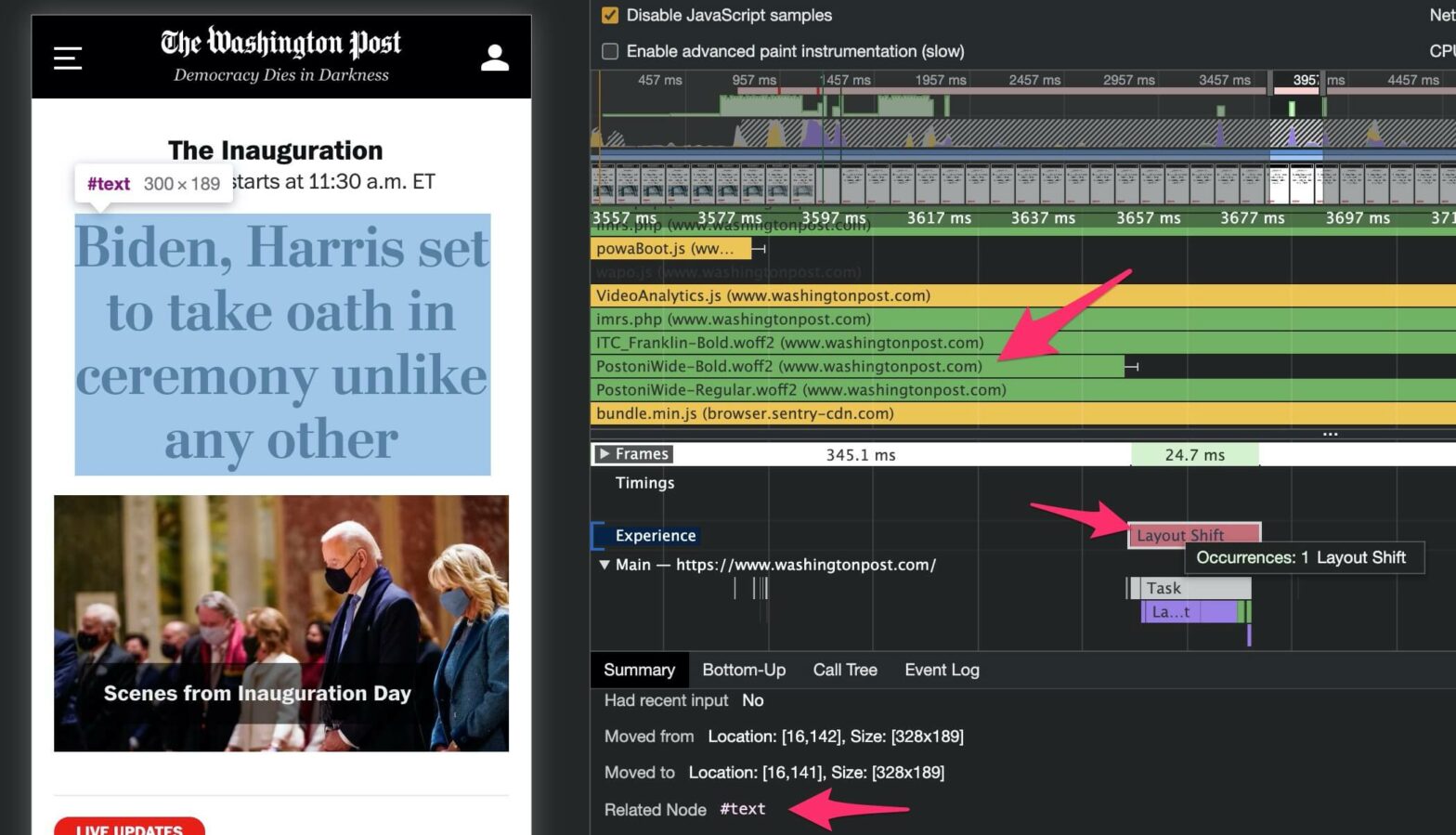
Interesting real-world case-study over at Smashing Magazine: In this article, we’ll take a close look at some of the changes we made on this very site — running on JAMStack with React — to optimize the web performance and improve the Core Web Vitals metrics. With some of the mistakes we’ve made, and some of …
Mads Stoumann, writing for CSS-Tricks, starts off with a simple idea: set a Custom Property to either playing or paused to control animation-play-state. [data-animation] { /* … */ animation-play-state: var(–animps, running); } /* Use a checkbox to pause animations */ [data-animation-pause]:checked ~ [data-animation] { –animps: paused; } But one of the listed use cases is …
Continue reading “How to Play and Pause CSS Animations with CSS Custom Properties”